Structure-stage growth in one year
Adults in a one-year transformational learning program at The New Human University grew about as much, developmentally, as adolescents do between 14 and 23.
What is structure-stage growth, and why should you care?
Every human being grows and develops, starting at conception. That development happens in the body and in the mind, and it happens in stages. On the outside, the body passes through well-known stages: fetal, infancy, childhood, adolescence, adulthood. On the inside, the mind matures through stages too: from archaic, to magic, to mythic, to modern and beyond. Each stage is a new and higher perspective, a new structure from which to make sense of the world. More complexity of brain and mind lets us handle more complex things in the world.
Two facts make this urgent. The complexity of the world is outpacing the complexity of the minds trying to navigate it. And in the overwhelming majority of adults, structure-stage development stops before the age of thirty. Fostering stage growth in adults is pivotal for the future of humanity.
It was once believed that cognitive capacity and intelligence were fixed. We now know both can change. It was also once accepted that stage growth ends before thirty. At The New Human University we’re cutting new grooves in consciousness and extending the growth trajectory of human beings.
Extending the developmental trajectory reliably and sustainably through practice has never been done before.
The study
Roman Angerer’s study, published in the International Journal of Psychiatry, tested whether adults in The New Human University’s one-year transformational learning program show measurable stage growth. It does three things:
- It introduces a new stage theory and assessment method, Transcendental Pluralism, which measures growth in consciousness and hierarchical complexity. This was the main instrument for measuring stage development across the year.
- It presents strong evidence of profound developmental growth in the program’s adult students.
- It compares that growth with other transformational learning programs measured by more standardized developmental assessments.
The results
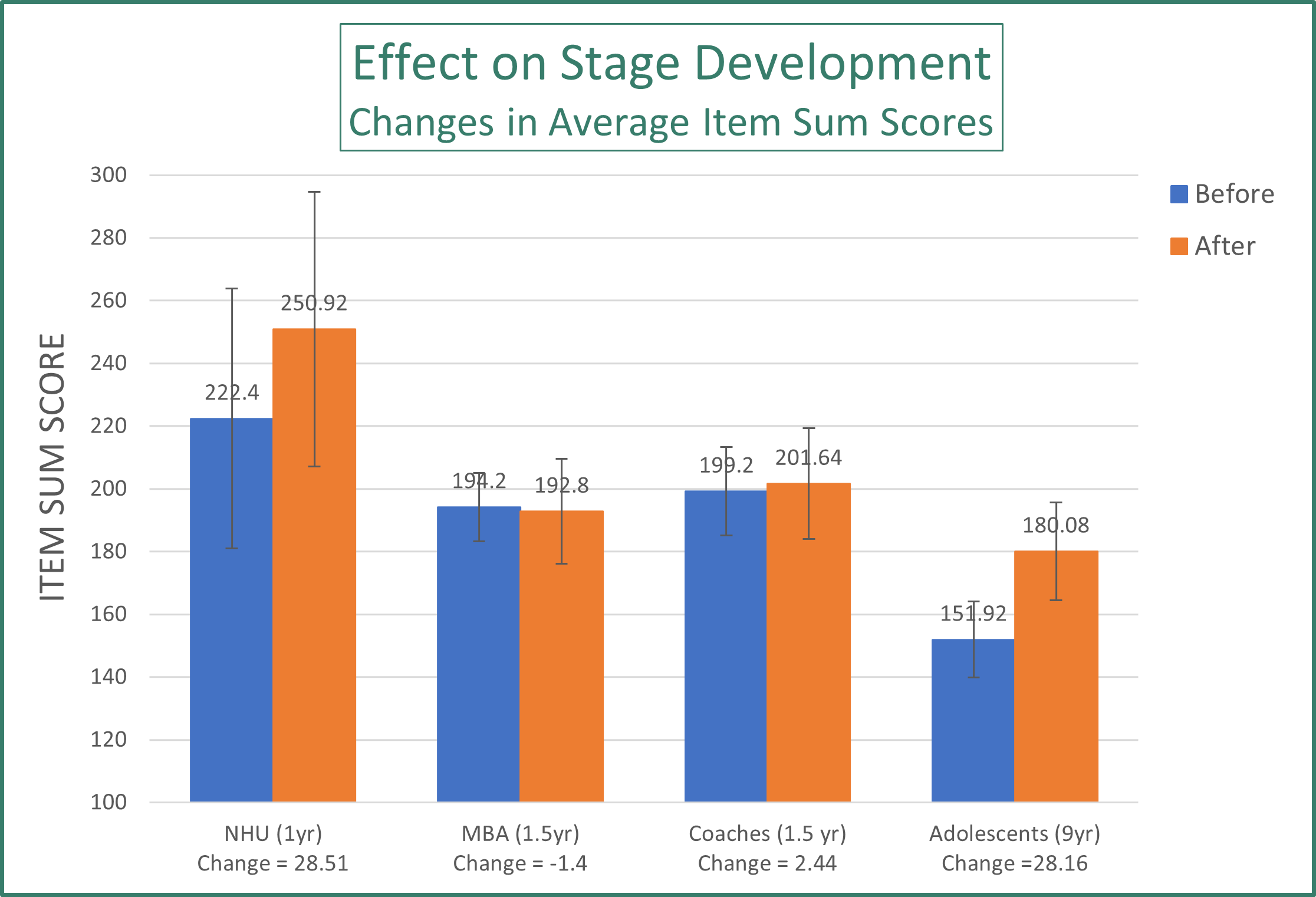
In the before-and-after assessments, NHU students showed a large positive change of 28.51 in their raw item sum scores on the developmental scale. That change happened in one year. It is roughly the same as the change of 28.16 that adolescents go through over nine years, from age 14 to 23.
Students of other transformational programs grew much less over a year and a half. Students in a coaching training program improved by 2.44 on average, 91.4% less than the NHU students. Students in an MBA program changed by −1.4.
| Group | Time | Before | After | Change |
|---|---|---|---|---|
| NHU students | 1 year | 222.40 | 250.92 | +28.51 |
| MBA students | 1.5 years | 194.20 | 192.80 | −1.40 |
| Coaching trainees | 1.5 years | 199.20 | 201.64 | +2.44 |
| Adolescents (age 14 to 23) | 9 years | 151.92 | 180.08 | +28.16 |
What’s next
This is the first piece of a larger research program at The New Human University. A stage-development study with Dr. Susanne Cook-Greuter, using her established ego-development assessment, is now in drafting.
Reference. Angerer, R. (2023). The New Human University study: Structure-stage growth in a one-year transformational learning program. International Journal of Psychiatry, 8(5), 139–149. Preprint: PsyArXiv ↗