The Art House.
Interactive immersion in art, light and sound. It grew out of weekly talks among a few graduate students, started in my basement and turned into packed events, free to anyone who came.
A renaissance for weary graduate students.
It began in graduate school. A few friends and I, some in physics and some in psychology, started meeting every week at coffee houses to talk about deep, important things. We kept it up for most of a year. It grew from there into songs around campfires and nights looking through telescopes. It was a kind of renaissance revival for a handful of weary graduate students.
What it showed me was how hungry people were for something creative alongside the work. I had a long list of things I wanted to try myself. Black-and-white photography. Glass. Oil painting. Clay. I didn't want to pick one. I wanted to make art in all of them. Each one needed equipment, space and someone who'd let you in the door, and there wasn't one place where you could just walk in and play with everything.
So I took it to the next level and made one. I set up the gear in my basement and invited a few friends. I had a hunch that I wasn't the only one looking for a creative outlet like that. It turned out I was right.
Studios in the dark, music upstairs.
I set up stations all around the basement, each one lit, the rest of the room kept dark. It gave the whole space a warm, low, art-house feel.
- Black-and-white photography, with a darkroom and an enlarger
- Glass work
- Oil painting
- Clay
- Drawing
- Music making, including computer music
Upstairs there was a dance party, with plenty of food and drink. Nobody was assigned anything. People drifted from station to station, or found one and stayed all night.
The events were free to anyone who wanted to come. Word got around, and a few friends in a basement turned into completely packed nights. They ran from 2004 to 2006.
Everything made there went on the walls.
There was one rule that made it different from a party: everything people created went up on the walls. Each night added to the gallery, so the next crowd walked into a room covered in what the last crowd had made. Nobody curated it. The Art House built its own collection, one night at a time.
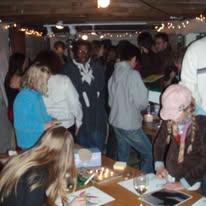
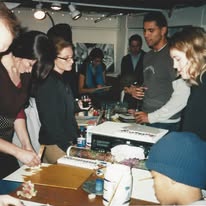
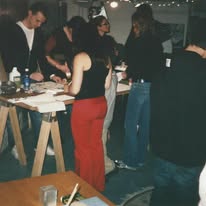
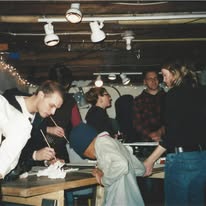
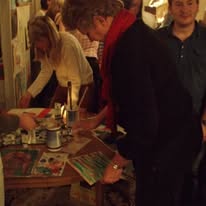
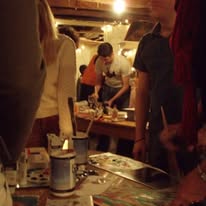
Photos from Art House nights, 2004–2006.
Build the room. Remove the friction.
People don't need to be told how to express themselves. They need a place where trying something costs nothing, where the tools are already out and nobody's watching the clock. Give them that and something switches on. And when you build it, the people who've been looking for it show up.
That lesson is the seed of Fulcrum Farms: a place where the tools for work, for growth and for the land are all already there, so people can stop looking for the door and walk in.